
By Erez Schnaider, Technical Product Marketing Manager, ClearML
Overcoming GPU Bottlenecks in AI Workloads
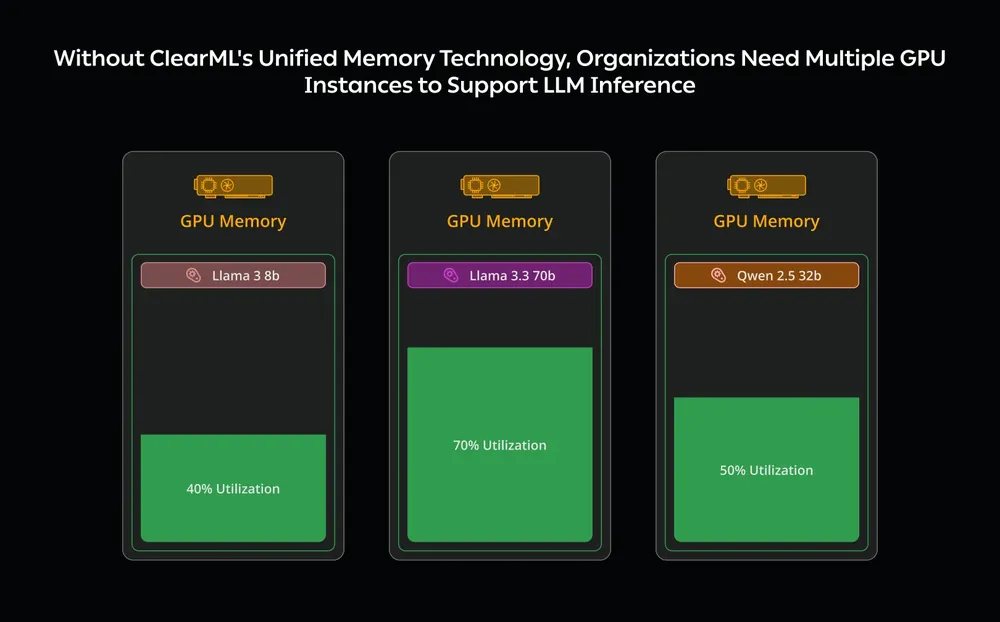
AI builders deploying models into production focus on ensuring well-performing models are available for users. Once the model is live, the focus shifts to optimizing GPU usage for efficient deployment. While GPU machines offer the best performance, they are costly to run and frequently remain underutilized. The issue becomes even more pronounced when each model runs on a separate GPU instance; this almost-linear increase in compute needs makes it harder for companies to scale their operations, increasing both deployment complexity and infrastructure costs.
Packing multiple models onto a single machine can sometimes help, but GPUs are limited by their VRAM size. If multiple models exceed available memory, they cannot be served simultaneously, thus requiring additional always-on resources. Since inference infrastructure is a major cost factor, optimizing GPU usage can determine whether an AI operation remains financially viable.
One way to mitigate costs is by spinning up instances only when needed. Unfortunately, this scenario introduces a cold-start penalty, as launching new instances can take several minutes, making it impractical for most use cases as users expect LLMs to respond in seconds. Even for use-cases that are not latency-sensitive, this requires setting up and maintaining an orchestration system that knows when to do so and that also has the capability of shutting them back down when idle.
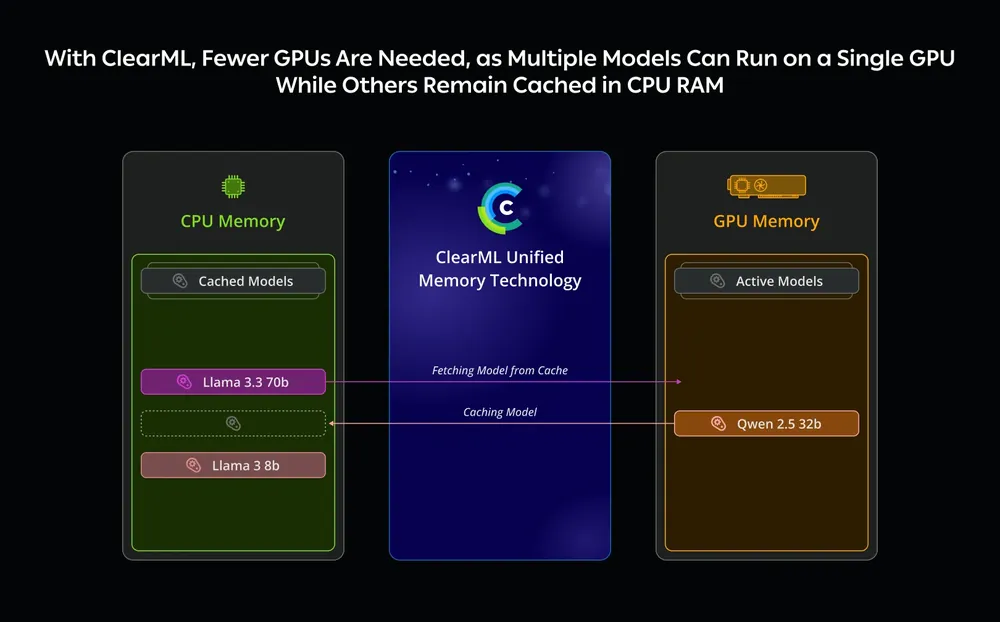
This is where ClearML’s unified memory technology comes in. When serving a model, the GPU is occupied so it’s critical to maximize its use; if the model isn’t actively using GPU resources, another model can make use of them. It seamlessly extends the GPU’s VRAM by offloading non-active models to the system’s RAM, which is often 10 to 100 times larger. This allows engineers and devops to run more models on the same hardware, reducing costs and simplifying deployment architecture while maintaining performance.
How It Works
ClearML’s Unified Memory Technology leverages the CPU’s RAM as a hot cache, storing cached models in system memory while keeping active models in VRAM for immediate access. In the event that multiple models fit within the available VRAM, they may remain there until the space is needed. When a cached model is accessed, ClearML seamlessly loads it from CPU RAM into VRAM (swapping out an inactive one), and executes it using the GPU’s superior compute power. Unlike engine-native approaches such as vLLM and llama.cpp, which rely on static or semi-manual configurations, ClearML’s Unified Memory Technology is fully dynamic, automatically swapping models in and out of VRAM based on real-time usage, with no need for manual setup, and no configurations needed.
This approach provides both high inference performance (in terms of tokens per second, by utilizing the GPU) and greater memory capacity through the CPU’s RAM.
Leveraging ClearML’s Unified Memory Technology results in higher GPU utilization, as a single GPU can now run multiple different models, and lower costs, as more models can be deployed on a single machine, helping companies scale their AI inference workloads.
Built-In, No Extra Configuration Needed
ClearML’s Unified Memory Technology is integrated into ClearML’s AI App Engine, which enables users to test and deploy LLMs with a single click without the need to manage infrastructure, configure deployment settings, or handle networking configurations for serving model endpoints.
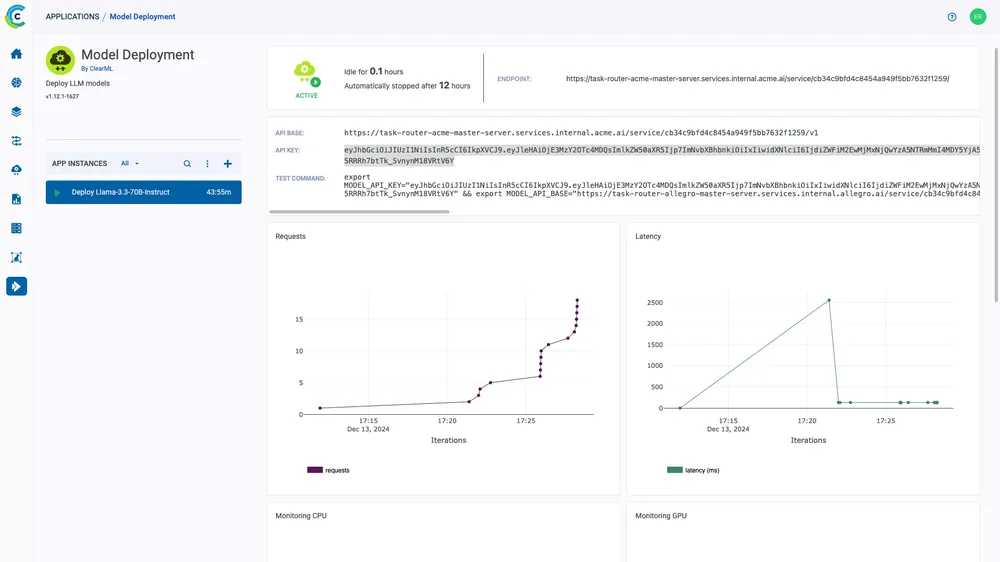
When a model is served using ClearML’s built-in vLLM or llama.cpp engines integration, it automatically loads the active models into VRAM. When a user needs to access a cached model, it is seamlessly swapped into VRAM and executed on the GPU. This process requires no manual configuration and no code changes, and supports both off-the-shelf models from Hugging Face as well as custom models stored in ClearML’s model repository.
Benchmarking
We took ClearML’s new Unified Memory Technology for a test drive using our vLLM serving engine, evaluating its impact on model loading speed and responsiveness.
Setup:
- Instance: AWS EC2 g6e.8xlarge with a single NVIDIA L40s GPU
- Serving engine: ClearML vLLM with Unified Memory and multi-model support enabled
- Models benchmarked:
- QWQ 32B (8-bit quantized) – ~32.5 GB
- Llama 3 Instruct 8B (16-bit float) – ~15 GB
- Llama 3 Instruct 8B (8-bit quantized) – ~8 GB
Benchmark Objective
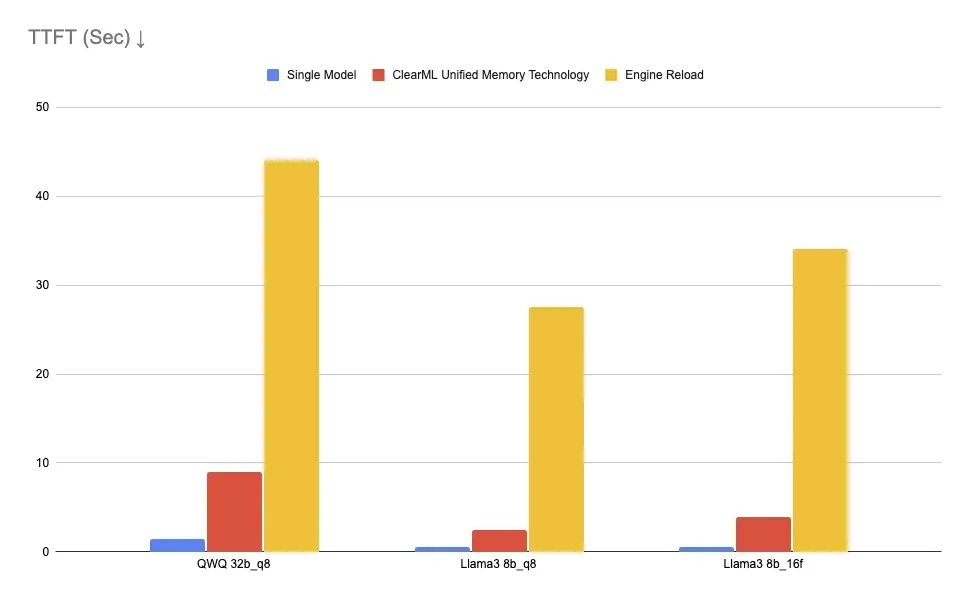
The goal is to assess Time to First Token (TTFT) under different scenarios:
- Single Model per Instance – How quickly a single “hot” model can respond when already active in memory.
- ClearML Unified Memory Technology – How long it takes to switch between models cached in CPU RAM using ClearML’s Unified Memory Technology.
- Engine Reload – The delay introduced when loading a model from disk, simulating cold starts when spinning serving engines up or down dynamically.
Time to First Token was measured in seconds.
Single Model | ClearML Unified Memory Technology | Engine Reload | Instance Cold-start |
|---|
Single Model | ClearML Unified Memory Technology | Engine Reload | Instance Cold-start | |
|---|---|---|---|---|
| QWQ 32b_q8 | 1.4 | 9.03 | 44 | 280 |
| Llama3 8b_q8 | 0.56 | 2.42 | 27.5 | 263 |
| Llama3 8b_16f | 0.51 | 3.97 | 34 | 270 |
Results
- Unified Memory achieved 11x faster TTFT than disk-based loading.
- As expected, CPU swapping incurs a latency overhead compared to having models resident in VRAM.
- Compared to spinning up new EC2 GPU instances (which can take tens of seconds to minutes), Unified Memory delivers more than 100x improvement in responsiveness.
This technology is effective for many use cases that don’t require strict real-time latency and offers substantial cost savings.
The Bottom Line
ClearML helps AI builders maximize their infrastructure, improve utilization, and reduce inference costs by extending the GPU memory onto the CPU’s RAM while maintaining reliable, high-performance AI deployments. With ClearML’s Unified Memory Technology, users can run more models on each GPU instance, with up to 100x improved inference latency.
Interested in seeing how ClearML can elevate your AI projects? Book a demo today to discover how it can accelerate your development and enhance efficiency.