
By Erez Schnaider, Technical Product Marketing Manager, ClearML
In a previous blog post, we laid the foundations for understanding multi-tenancy in GPU-access infrastructure and highlighted its critical importance. In this post, we’ll dive into ClearML’s approach to achieving secure and efficient multi-tenancy.
At a high level, multi-tenancy refers to the ability to share a single resource pool, typically GPU or CPU clusters, across multiple, logically isolated entities known as tenants. A tenant could represent an external customer in a multi-client environment or an internal division, such as a team or business unit, within a large organization. Regardless of structure, each tenant expects secure boundaries for data, compute, and identity.
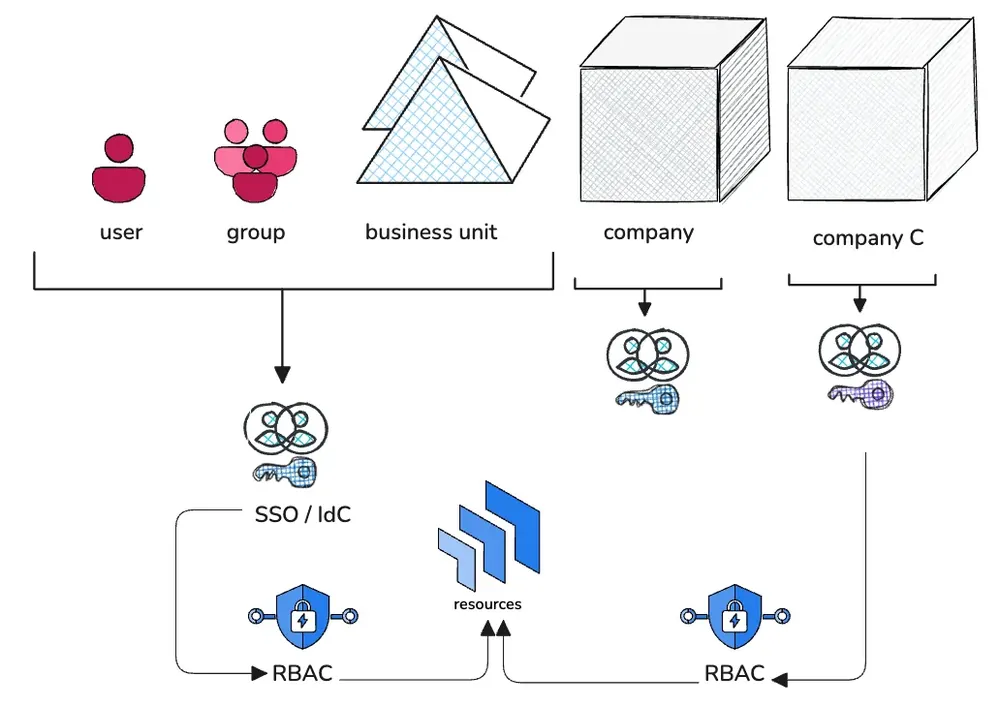
In ClearML’s model, each tenant is fully isolated at the identity level, with its own dedicated SSO or Identity Provider (IdP). No two tenants share an authentication system, and a single user cannot belong to multiple tenants. Inside a tenant, fine-grained role-based access control (RBAC) is used to manage permissions between different users and groups.
In some cases, different Kubernetes clusters per tenant will be created, ensuring the highest level of separation is maintained. ClearML can manage multiple clusters within the same platform, exposing tenants to the relevant clusters.
Do I Need Secure Multi-tenancy Capabilities?
Why multi-tenancy? Why not simply have a large GPU pool that everyone can use as needed? Usually it’s because there are multiple technical challenges that need to be resolved.
The first challenge lies in data privacy and security. For cloud service providers (CSPs), this means isolating data between customers, while for enterprises, it involves maintaining strict separation between teams working on confidential projects.
The second challenge is resource allocation. A shared pool operating on a “first-come, first- served” basis fails when an urgent workload arises but resources are already allocated.
One can statically allocate resources, but that’s not a perfect solution. As GPU utilization becomes an important consideration for IT teams, statically allocated resource are guaranteed sit idle at some point (e.g., during a team’s downtime) and can’t easily be used by other teams, even if they urgently need them. We’ve covered resource management in another blogpost, but ensuring that different tenants sharing the same resources (even the same GPU with fractional GPU) can’t access each other’s data is crucial for secure multi-tenant architecture.
Multi-tenant Architecture
Control-plane Multi-tenancy
ClearML’s Infrastructure Control lane manages AI research and infrastructure using a fully multi-tenant architecture. As mentioned before, each tenant is fully isolated, with a unique identifier and a dedicated identity Provider (SSO/IdP), ensuring strict separation of resources. Projects, experiments, datasets, deployed endpoints, and other entities are tenant-scoped – no two tenants can ever access or view each other’s assets.
Within each tenant, ClearML enforces RBAC rules to manage visibility and permissions. RBAC governs access not only to ClearML entities like projects and datasets, but also to hardware resources exposed through queues. Queues abstract GPU and CPU resources, and RBAC rules define which users or groups can view and submit workloads to specific compute resources. In this way, RBAC provides intra-tenant separation across both data and compute layers.
Compute Multi-tenancy
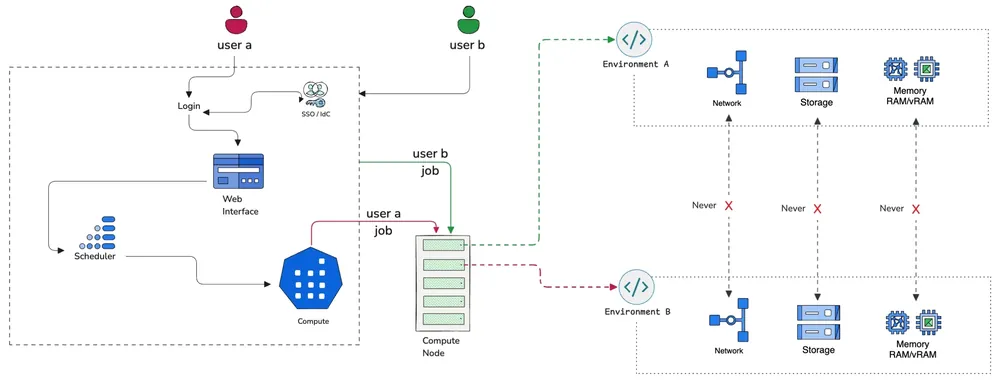
The second key aspect of multi-tenancy is managing the compute infrastructure. The objective is to share a pool of resources while ensuring tenants remain completely isolated — not only unable to access, but also unaware of each other’s resources. In some cases, complete separation is required, and ClearML supports assigning dedicated clusters to specific tenants. In others, multiple tenants may share the same cluster, with strict isolation enforced by the platform.
ClearML’s architecture supports multi-cluster configurations, allowing administrators to mix dedicated and shared clusters as needed. While static resource allocation at the Kubernetes, network, or physical level guarantees isolation, it often results in underutilization and operational friction. ClearML offers dynamic resource allocation, giving each tenant both guaranteed resources and access to additional capacity when available. Each tenant has a reserved quota for predictable planning, along with an over-quota allowance for burst usage. This approach combines the predictability of static allocation with the flexibility of dynamic scaling, ensuring high cluster utilization without the waste of over-provisioning.
Kubernetes has become the industry standard for infrastructure orchestration, providing powerful tools for scaling and resource management. However, it was not originally designed for secure multi-tenant environments. Granting users direct access to the Kubernetes API can expose them to low-level infrastructure primitives, such as shared networking or persistent volumes, that may compromise tenant isolation. In fact, the official Kubernetes documentation recommends using dedicated clusters for strict separation between tenants in many cases.
ClearML addresses these limitations by acting as a secure abstraction layer between users and Kubernetes. Users submit jobs through ClearML’s platform, not through Kubernetes, eliminating the need for low-level access or Kubernetes expertise. This design improves usability while also reinforcing tenant isolation. Only cluster administrators interact with Kubernetes directly, maintaining centralized control over installed Kubernetes Applications, resource quotas, and infrastructure configuration.
ClearML directly interfaces with Kubernetes, leveraging standard primitives to enforce separation within shared clusters while abstracting Kubernetes from users submitting jobs for execution. Each tenant is isolated using distinct namespaces, software-defined networking, and dedicated storage volumes – all based on native Kubernetes constructs designed for multi-tenant scenarios.
Beyond Multi-tenancy
ClearML’s multi-tenancy solution goes beyond basic isolation to deliver added operational value. It enables secure service exposure by enforcing tenant-specific authentication and authorization, ensuring that only authorized users can access deployed resources such as model endpoints. It also supports capacity sharing by combining guaranteed per-tenant quotas with the ability to burst into shared infrastructure, allowing service providers to offer flexibility without overprovisioning or relying on external compute vendors. Finally, ClearML provides built-in usage-based billing, tracking compute, storage, and API consumption per user, project, or tenant. This empowers both enterprises and service providers to implement customer invoicing or internal chargebacks with minimal overhead. These capabilities are all made possible by ClearML’s multi-tenancy architecture.
Conclusion
Secure multi-tenancy is essential for scaling modern AI infrastructure across internal teams, business units, or external customers. ClearML delivers on this need by combining strong identity isolation, dynamic resource allocation, and infrastructure abstraction — all while streamlining the user experience and centralizing operational control. Whether you’re exposing internal resources to different business units or delivering AI-as-a-service to external clients, ClearML provides the flexibility, security, and efficiency required to operate multi-tenant environments at scale. If you would like to see ClearML’s multi-tenant architecture in action, please request a demo.